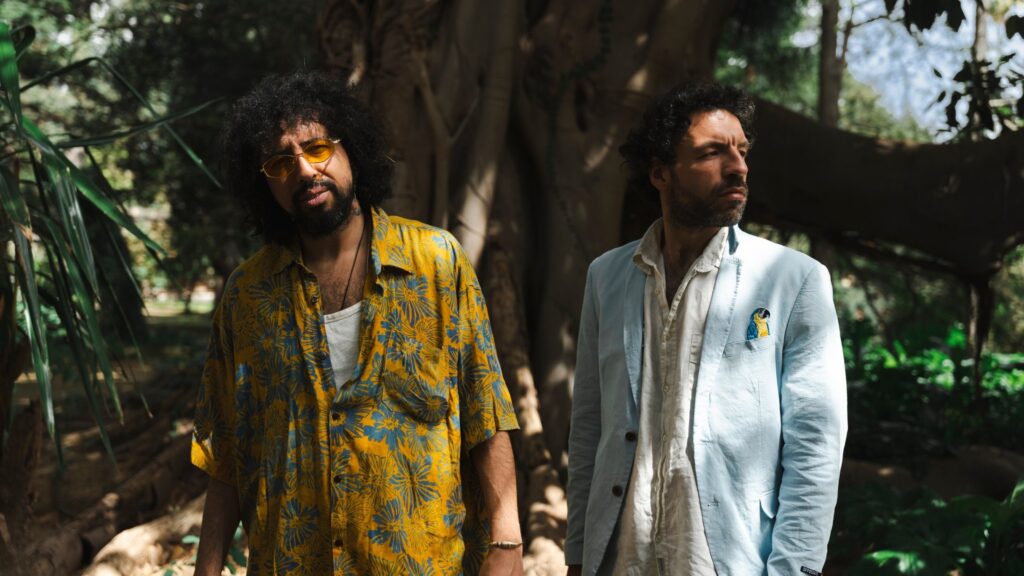
Parbleu may be rooted in Italy, but their music knows no borders. Based in Naples, the band draws inspiration from their heritage, but refuses to be confined by it. They love to travel, to explore, and to experiment. You can hear it in the way Afro-Cuban percussion blends with Iranian strings, or how Brazilian grooves meet Mediterranean melodies. Their sound is a living experiment: a fusion of funk, disco, and global rhythms that moves both body and mind. It’s music made for the dancefloor, but layered with stories of love, politics, and human connection. We spoke with Andres Balbucea and Andrea De Fazio about their roots, the meaning behind their music, and why fusion is more than just a musical style. It’s a way of life.
⸻
Introduction
What does the name ‘Parbleu’ mean?
We were searching for a name that combined our Neapolitan dialect with a bit of French flair. In our dialect it means blue, but “Parbleu” is also an old French exclamation, used when something surprising or even unfortunate happens. It felt like the perfect match for the time we were living in: right after lockdown, in a chaotic and surreal world that’s getting worse and worse. And next to that, we liked the sound of the word. So Parbleu it became.
How would you describe your sound to someone who’s never heard your music?
It’s not easy to describe our music. It isn’t ‘pure’ in the traditional sense, like you can describe it as ‘jazz’ or ‘rock’ for example. It’s fusion. You’ll hear elements of funk, disco, Afrobeat, world music and folk. We mix a lot of styles, we touch music from our Italian and Midterranean roots, but also Asian influences and South American rhythms. We love experimenting and seeing what comes out, sometimes it’s good and sometimes it is not. But in general this kind of fusion is what matches this day and age.
What themes or stories do you explore through your songs?
Many. Some are political, some are about love. We explore different themes. For example, Atlas from our first album tells a story of love and cosmic distance, inspired by the Atlas comet that narrowly missed Earth in 2020. We tried to put this story in a story about two lovers that want to keep in touch, but one of the lovers slowly moved away and over time she became like gas. She disappeared and the love ended. Then there’s Père-du-perdu , based on a poem written by a child to his refugee father in Palestine, begging him to come home so they wouldn’t die apart. But’s not always about love and distance. Sometimes we capture what we experience in life, like in Guillotière. That song was written after an encounter in Lyon, we had a conversation with someone in which we explored the tension between universal and formal justice. But we also have lighter songs like Danse Cette Zik, which is all about keeping the tempo, dancing and feeling the groove.
⸻
Roots
Did your cultural background shape your sound?
Sure. We all come from different musical paths. I’ve studied jazz and played pop and funk. Andrea has deep roots in jazz and soul. But it’s also about our Mediterranean identity, we love to dance, we love to party. So we mix that 70s–80s soul and disco with today’s dancefloor energy. But it’s not only our own heritage, we love to travel. And wherever we go, we pick up instruments and new sounds that we can use in our music.
What traditional instruments do you use?
A lot. From our own Italian heritage we use the Mandolin. But we use a wide range of traditional instruments from different regions, like bata drums from Afro-Cuban traditions, the Japanese koto, Middle Eastern strings, and even the kamalengoni. The latter one is the grand-grandfather of the guitar, which we discovered while visiting a friend. We had never played it before, but ended up spending three days jamming with it and having fun. We liked the sound and it became part of Père-du-perdu, our newest track. We’re fascinated by how instruments carry sounds and energy from their places of origin.
You mix so many sounds and influences, what does fusion mean to you?
It’s kind of the meaning of life, no? Bringing together different people, feelings and experiences. It’s a playful and beautiful approach to both, music and life. That’s what we try to do, and we like it, so we keep doing it.
That’s beautiful. How do you see your role in building bridges between cultures through your music?
That’s a deep question. Maybe, yeah – by mixing sounds and languages, we connect and get in touch with people from all over the world. But honestly, we’re just doing what we love. We make music, we have fun, and step by step, that creates connections. It’s a continuous process, so maybe in a few years we’ll have a better answer to this question. Let’s do another interview then!
⸻
Live
Your shows are full of energy. What do you hope people feel when they see you live?
We want people to dance, of course. But also to feel something deeper. Sometimes you don’t catch all the words, but the vibe speaks for itself. We want to communicate and express our ideas on all levels. It’s a way to connect with people. But a serious song, can still have good vibes. You attract the attention with sound and share your thoughts through the lyrics.
Do you have a live moment you’ll never forget?
Playing at Oerol Festival in Terschelling, The Netherlands, this summer was magical. People of all ages dancing together. It wasn’t just a crowd, it was a community. It was the longest day of the year and the sun didn’t set until 11 PM, so it felt surreal. It was the dream. Another show I will always remember is our first show after the lockdown at Maki Music Festival in Paris. That moment of being back on stage, close to people again, sharing music in the sunset. It was pure liberation after a difficult period.
⸻
Inspires
What’s next for Parbleu?
We have a few summer shows coming up in Italy, and then we’ll take a break to work on new songs for our new album. But, we don’t want to rush it. We’ll be in the studio in September and October. Hopefully it’ll be ready by spring, but creativity doesn’t follow a strict calendar.