
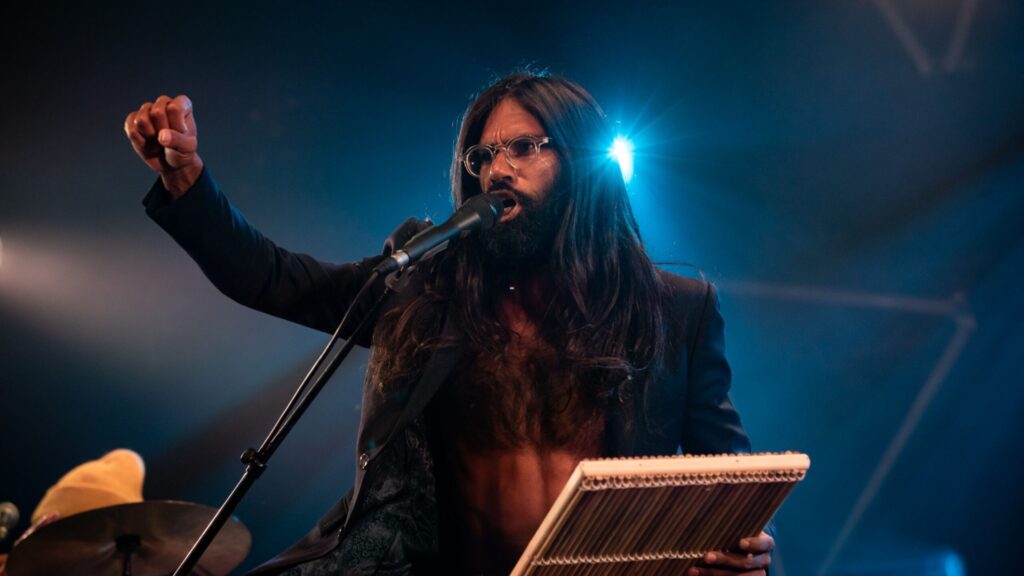
From the Indian Ocean island of Réunion comes Mouvman Alé, a project rooted in rhythm, percussion, singing, ancestors, sound, and the remarkable capacity for transformation inherent in Reunion culture. Led by Franswa Virassamy-Macé, the group blends ancestral drums, Creole storytelling and trance-like structures into a deep musical experience. For Mouvman Alé, music is not just performance. It is vibration, freedom and connection. In this our conversation, Franswa reflects on the philosophy behind the name, the legacy of the maroons, and how tradition and experimentation meet in their sound today.
⸻
Introduction
Where does your artist name come from?
At the start of the project, I immediately settled on a name that some people found unattractive, or even hideous. What is beautiful, and what is ugly? It’s all about the energy you put in it. In Reunion, we say “in mouvman” when something is happening. It may just be a few people gathering and doing something together. Even three people can create a movement. So, naturally, one of the group’s slogans in Reunion Creole happens to be: “la pa bézwin in ta domoun po fé in mouvman”, we don’t need a lot of people to create something powerful. At the beginning, we never expected the project to travel outside the island, it was only about expressing ourselves. Even today that spirit remains the same. Wether we play for ten people or a full venue. The goal is to express, create and share energy.
How would you describe your music to someone who’s never heard you before?
In English I call it “updown music.” The emotions move constantly. In French and even in Creole I say “marron progressif.” The Maroons were people who rejected their status as slaves and chose instead to flee and hide in the mountains. They represent a powerful symbol of freedom in the history of Réunion and many other places. Our music keeps the traditional maloya drums, but we also experiment and push forward. It’s about freedom, musically and spiritually. It’s always the question what it’s be like to be a marron in 2026.
Réunion has such a rich cultural background. Which part of your roots feels most important to you?
Réunion is a very mixed place. Our culture contains influences from Madagascar, Africa, India, China and Europe, and many people on the island are themselves mixed. Because of that, our traditions already carry a kind of universality. Sometimes we don’t even know where certain rhythms or ideas originally came from. They simply became part of the culture over generations. For me, my roots are deeply connected to that mix. My work is to explore what is unique about Réunion while recognizing that it already contains something universal.
⸻
Roots
What influences your music today?
These days my main influences are not necessarily other musicians. Of course I listened to a lot of music when I was younger and those sounds remain somewhere inside me. But today what inspires me most is simply life, the people I meet, the emotions of the day, or what is happening socially and politically in the world. All of those things eventually find their way into my music.
What instruments and elements define the Mouvman Alé sound?
At the heart of our music is the rouleur, the large drum used in maloya. It carries a very particular vibration that I feel is essential. Without that drum I cannot really play this music, it’s like the heartbeat of our music. With the drum, a lead voice and backing vocals you already have the foundation. From there, depending on the style of set we’re playing – whether it’s electronic or acoustic – we add certain instruments. Lately, we’ve been really enjoying playing our songs acoustically, so that our audience can appreciate them with an acoustic bass, a double bass, an acoustic guitar and, of course, various percussion instruments. But the real idea is to take time with the music, and let the song grow slowly, a bit like in the Indian raga.
Do you see a role for yourself in bridging cultures through your music?
I don’t really see it as a mission. I’m simply a musician who plays and takes part in it just like everyone else. But it’s true that music creates vibrations, and those vibrations bring people together. If, through our music, we manage to forge links between cultures or communities, that’s something wonderful. I feel I have things to say, and I believe I have a powerful, positive energy, and I use music to get all that out there.
⸻
Live
What do you want people to experience during your performances?
My goal is very simple: to share the same frequency with the audience. For one hour or more we try to reach a place where everyone feels connected through the rhythm and the creole words. People will live a collective experience. Every performance today offers an opportunity to share a group sound that is constantly evolving, both in terms of its musical character and the diverse range of musicians who are involved or will be involved in the project. It’s less about the technical side of the performance and more about that shared vibration. Recently I’ve also been exploring a more minimal approach. Less technology, fewer layers. Just the raw energy of the music.
Is there a live moment that stayed with you?
Yes, a concert in 2006 where only seven people came to watch. It might sound strange, but it was actually more difficult than playing for a big crowd. When there are thousands of people you can disappear into the mass. With seven people it becomes very direct, almost like looking each other in the eyes the entire time. But we played for an hour and a half and managed to connect with them completely. That moment stayed with me because it reminded me that you don’t need a large audience to create something powerful.
⸻
Inspires
What’s next for Mouvman Alé?
Last month, we’ve just finished our first 2026 European tour with the new acoustic version of the project. It was brilliant with the audience, and all the time, having new musicians on board really added to the excitement. Now, in April, we’re really looking forward to presenting our new music video, which is a cross between a clip and a live session.