
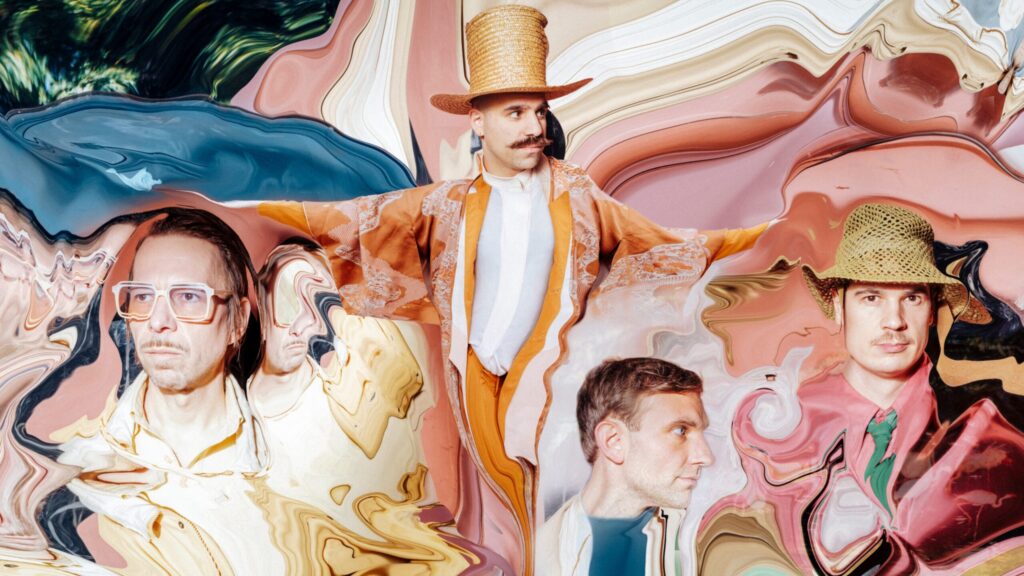
Blending krautpop, dub, Indian rhythms and otherworldly textures, Keshavara doesn’t just make music, they live it. What began as a solo project by frontman Keshav has grown into a full live band, known for hypnotic performances and boundary-blurring sounds. We spoke with Keshav and drummer Niklas about the roots of the project, the influence of Keshav’s musical father, and why he prefers portals over bridges when talking about culture.
⸻
Introduction
What does the name ‘Keshavara’ mean?
The name is based on my first name, Keshav. When I started this project back in 2016 as a solo act, I wanted the name to reflect something personal. Over time, though, it evolved from solo to a duo, and now we’re a full four-piece band. The word itself, Keshavara, loosely translates to “the one with the beautiful hair,” which still makes me smile when I think about it.
How would you describe your music to someone who’s never heard you before?
That’s always a tricky one, but someone once wrote in an article: “Keshavara creates music like other people mix their cocktails after they already had three: washed-out krautpop and diasporic dub excursions, roughly measured out and then shaken wildly.” It’s not fully our own, but this description really resonated with us.
What kind of stories do your songs tell?
They’re more like fragments or mantras than linear stories. A lot of it happens in between worlds, between India and Germany, for example. That in-between space is always fascinating to us. We’ve written weird love stories between ghosts, planets, and even entire cities. So we have a wide variety of themes.
⸻
Roots
How have your German and Indian roots shaped your sound?
I was born in Germany, but my father is from South India. We moved to India when I was three, and I started school there before coming back to Germany. My dad is a musician, he started as a rock drummer covering Led Zeppelin and Jimi Hendrix, then dove into South Indian classical percussion, especially the Tavil, a powerful temple drum. I grew up backstage, surrounded by music, and weird instruments he collected on flea markets. That shaped how I hear the world. I still carry those sounds with me, like the Indian mouth harp, the Morsing, or the rhythms of the Tavil. And the interest in weird sounds has stayed with me too, with Keshavara we’re always looking for weird sounds to add to our palette.
Do you also use all those weird and unique sounds during your live shows, or mostly in the studio?
Mostly in the studio. Our live approach has become more and more organic, we try to really play everything live without relying on backing tracks. That makes the performance more raw and connected. In the studio, though, we’re completely open. We’ll use anything that appeals to us, from strange toy sounds to traditional percussion. Some of it just isn’t practical to reproduce on stage. But when we play in our hometown, Cologne, and my dad can join us, we sometimes manage to recreate that full studio experience live. That’s really special.
You are inspired by India, krautrock and also dub, what does the word fusion mean to you?
Honestly, weve always had a strange relationship with that word. In India, “fusion” often just means mixing Indian classical music with something Western, and we never liked that label. To us, blending influences is natural, it doesn’t need branding. Music evolves on its own. Calling it “fusion” almost makes it feel forced or artificial.
Many artists feel uncomfortable with the label “fusion.” Do you have a better word for it?
That’s a tough one, we’ve talked about it a lot ourselves. Terms like global or world music can feel strange too. They often seem to define music simply by the fact that it doesn’t come from Western Europe, which is kind of absurd. So no, I don’t really have a perfect alternative. Maybe we should use ‘international music’ or ‘transcultural music’, that might fit well.
Do you see a role for yourself in building bridges between cultures?
The phrase “building bridges” sounds a bit diplomatic. It’s not wrong, but maybe a little too clean. I prefer to think of it as creating a portal between memory and moods. Cultures already overlap and blend constantly. Music can make that visible. As a portal, not a bridge.
⸻
Live
What do you want audiences to feel during your live shows?
We want it to feel like a trip, like traveling through space together. But more and more, it’s also about coming together as human beings in a small community. With everything happening in the world, and the fast-paced nature of digital life, these small shared moments feel precious. Sometimes our concerts become one collective experience, not “us on stage” and “them watching,” but a kind of unity. Toward the end of the show, we often build up to a dance moment where we join the crowd. It’s always about presence, being fully there. When we manage that, the energy in the room rises naturally and the connection with the audience becomes stronger. That’s the magic.
Is there a live moment that stuck with you?
Yes, Duna Jam, a secret psych-rock festival in Sardinia. It’s invite-only, with just 250 people, we played right by the sea. During the final song, I thought: this is a once-in-a-lifetime moment—so I jumped into the ocean for a swim while the band kept playing. I came back soaking wet and finished the song on stage. Totally surreal and unforgettable.
⸻
Inspires
What’s next for Keshavara?
Right now, we’re working on our next album, which is going really well, it should be out next year. We also have a Scandinavian tour lined up in February, and some East European shows in places like Warsaw. We’re also working on a collaborative EP with my cousin Sana, who’s a singer from Bangalore. We want to make a Tamil-language record, inspired by old Tamil movie soundtracks. That’s a really exciting project.