
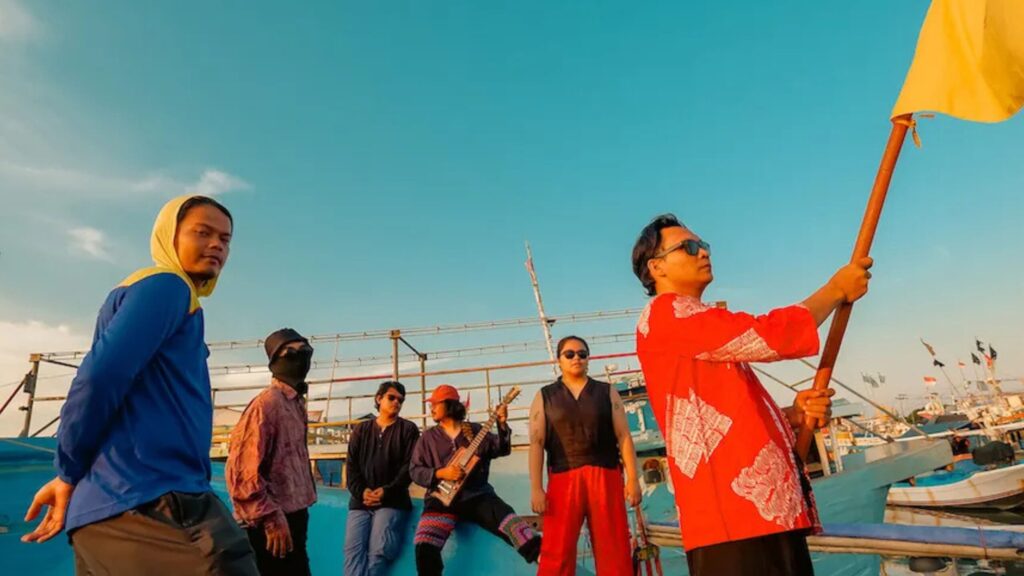
Some bands are inspired by a place. LAIR is built from one. Hailing from the north coast of Java, Indonesia, LAIR emerged from the Jatiwangi Art Factory community, located in one of Southeast Asia’s largest roof tile producing regions. Surrounded by clay workers, ceramic artists, musicians, and storytellers, the band has developed a sound unlike anything else: guitars made from roof tiles, clay percussion instruments, and songs rooted in everyday life. LAIR transforms the stories of ordinary people into vibrant, danceable music that bridges generations while staying deeply connected to its roots.
⸻
Introduction
What does the name ‘Laïr’ mean to you?
The name comes from the word lahir, which means “born” in Indonesian. In our region, which sits between Javanese and Sundanese cultures, people speak a local language influenced by both traditions. In the Cirebon area, lahir is often pronounced as lair. The name felt right because the band itself was born from our community and from the cultural traditions that surround us.
For people discovering Laïr for the first time, how would you describe your music?
It’s difficult to compare LAIR to anything else because our sound comes directly from where we live. We grew up in a region known for its clay and roof tile industry, and that environment naturally shaped our music. People often tell us that the sound feels unfamiliar at first, but in a good way. The instruments look different, the textures are different, and even visually the band stands out. We think that’s because everything starts from our community and our landscape. The music carries the character of the place where it was born.
What themes return in your music?
Almost everything comes from real life. We don’t usually write about abstract concepts. Instead, we look at the people around us, the stories we hear, and the situations unfolding in our communities. One song from our first album was inspired by a friend who was running to become a village leader. Through that story, we explored how power, money and politics can influence people’s decisions. Another song follows the perspective of a truck driver travelling along Java’s economic routes. People often complain about heavy trucks damaging roads, but we wanted to understand the driver’s side of the story too. He’s working hard to support his family and make a living. On our second album, we also explored local folklore and urban legends. One song was inspired by a mysterious story from a nearby village where strange faces suddenly appeared on houses and even on a mosque. Nobody ever discovered who was responsible, and over time the story evolved into local folklore.
What makes the Laïr sound unique?
One of the most recognizable elements is the use of large horn speakers. In many Indonesian villages, especially during Ramadan, musicians walk through neighborhoods before dawn to wake people for the pre-fast meal. Those mobile performances often use large mosque-style horn speakers. We grew up hearing that sound. It became part of our daily lives, so naturally it found its way into our music. Combined with the clay instruments, it creates a sound that feels very local to us but completely new to many listeners.
⸻
Roots
How has your local community shaped the band?
Completely. We come from a community of workers, artists, musicians and craftspeople. Many people around us work in roof tile factories or with clay and ceramics. Those are the people we see every day. When we make music, we often think about them. We want our songs to feel close to ordinary people and everyday life. In Indonesia we would call it music for the grassroots. The community is not just the inspiration for the music. It is also part of the band’s identity, from the instruments we use to the stories we tell.
Laïr is known for its unique instruments. How did those come about?
Everything starts with clay. Our hometown is one of the biggest roof tile producing areas in Indonesia, so clay is everywhere. Many people in the community work with it every day, whether in factories, workshops, or ceramic studios. Because of that, we started asking ourselves a simple question: if we can make roof tiles from clay, what else can we make? That curiosity led to instruments. We began experimenting with clay guitars, ceramic flutes, percussion instruments and large clay drums. Some of the instruments are built from roof tiles themselves. Others are made through collaborations with ceramic artists and craftspeople from the community. Jatiwangi Art Factory is also a place where artists regularly visit and work in residence, so new ideas are constantly emerging.
How do new Laïr songs come together?
Usually the music starts with our guitarist, Teddy. The lyrics and stories are much more collective. One person might begin with a single word or idea, then another person adds something, and then someone else continues the story. The songs grow naturally through collaboration. In many ways, the writing process reflects how the band itself works, as a community.
What does musical fusion mean to Laïr?
For us, fusion is not simply about combining traditional and modern sounds. It is about keeping traditions alive. We come from the Tarling tradition of the north coast of Java, but we don’t want to recreate the past exactly as it was. Instead, we take the sounds, stories and spirit of that tradition and bring them into the present. By doing that, we hope younger generations can connect with something that might otherwise feel distant or unfamiliar. In that sense, LAIR acts as a bridge between generations. Older generations recognize the roots of the music, while younger listeners discover those traditions through a sound that belongs to today. We see it as a way of making cultural heritage continue to grow rather than simply preserving it as a memory. Our goal is that the traditions we grew up with remain relevant, accessible and alive for the next generation. That’s what fusion means to us.
Live
What do you hope audiences experience during a Laïr performance?
We want people to have fun. We want them to dance, sweat and feel connected to the energy coming from our part of Java. Some songs are more reflective, but live performances are about sharing joy and bringing our landscape, culture and community to audiences everywhere. Whether we play in a village square or at a large international festival, that feeling remains the same.
You’ve played major festivals like Lowlands, but what has been your most memorable performance?
Playing Lowlands was a huge moment for us. It was one of the biggest stages we had ever performed on and it introduced our music to a completely different audience. We were nervous, but it became an unforgettable experience. At the same time, some of our most meaningful shows happen much closer to home. Every August, around Indonesian Independence Day, we sometimes travel from village to village bringing our own sound system and instruments. Many of these places rarely host live performances, so music becomes a way to connect people. Those village shows are incredibly special. They allow us to meet people directly, share stories, and build relationships with communities that feel very close to us. In many ways, those performances capture the true spirit of LAIR.
⸻
Inspires
What’s next for Laïr?
We’re currently working on our third album. Beyond that, we dream of taking the band further along historic cultural routes, including a tour that follows parts of the old Silk Road. The idea of connecting communities through music, just as stories and cultures have travelled for centuries, is something that deeply inspires us. For now, we’re continuing to create new music, tell new stories, and carry a piece of our community wherever we go.