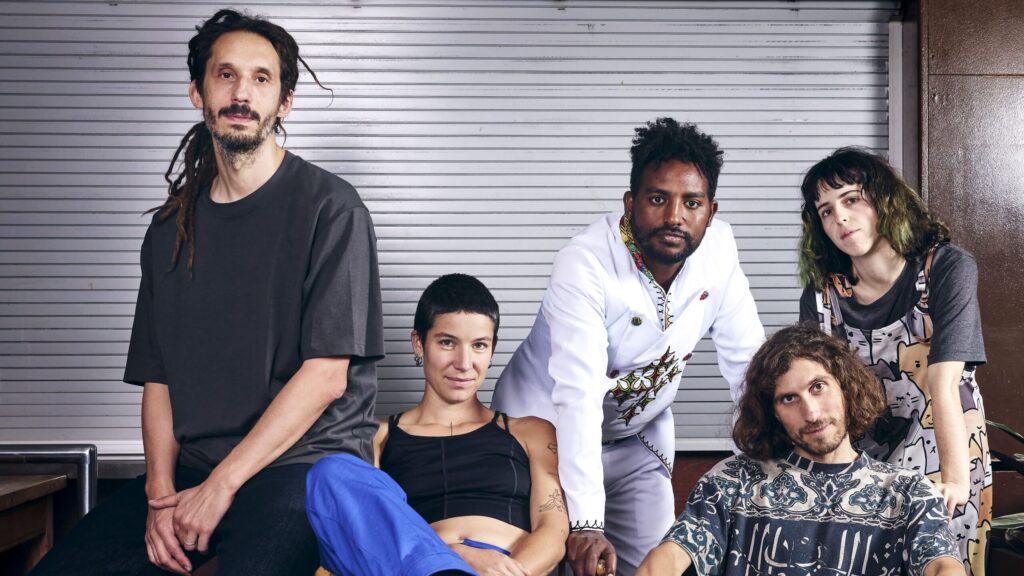
What happens when musicians from Eritrea, Lebanon, Morocco, Algeria, France and Switzerland stop trying to fit into existing genres and instead build something entirely new? For Yalla Miku, the answer lies somewhere between traditional music, punk spirit, electronic experimentation and personal storytelling. Founded by Cyril Yeterian of Geneva’s renowned Bongo Joe collective, the project brings together musicians from different cultural backgrounds who each contribute their own stories, languages and instruments. In this conversation with Durum Records, Cyril explains how Yalla Miku became a reflection of Geneva’s multicultural underground, why the band prefers creating a new musical language over “fusion,” and how migration and identity continue to shape their music.
⸻
Introduction
The name Yalla Miku is quite unique. Where does it come from?
“Yalla” is one of the most common words in Arabic. It means something like “let’s go” or “come on,” and it’s used constantly in everyday life. It’s an ancient word that carries a lot of cultural history and is connected to many non-Western traditions. “Miku” comes from Hatsune Miku, the Japanese virtual pop star. She doesn’t physically exist, yet she has millions of fans around the world. Bringing those two words together felt right. It reflected both the spirit of the project and the worlds we are connecting through music.
How did Yalla Miku start?
The project grew out of my life in Geneva and my work with Bongo Joe. Geneva is often seen as the city of international institutions, diplomats and expats, but there is another side of the city that interests me much more. There are communities from all over the world living here. Many migrants and political refugees have arrived in Geneva over the years, and through our venue and record store we met musicians who were trying to rebuild their lives while continuing to express themselves through music. Yalla Miku started as an attempt to show this other Geneva, the multicultural Geneva of the streets, the underground and the communities that rarely get represented. When I received a carte blanche from Cave 12, an important experimental venue in Geneva, I invited friends from Eritrea, Morocco, Algeria, Lebanon, France and Switzerland to create something together.
How would you describe your sound to someone who’s never heard you before?
It’s honestly difficult. I remember our first rehearsal. I was counting “one, two, three, four,” and everybody seemed to start at a different number. That pretty much summarizes the project. There are influences from traditional music, electronic music, post-punk, folk, free jazz, krautrock and underground experimental scenes. But none of those labels fully explain what we do. What interests us is the unknown. We don’t start with a predefined genre. We start with people, backgrounds and ideas, and then we see where the music takes us. More than anything, Yalla Miku is an attempt to create a new musical language.
What themes return in your music?
Every member brings their own experiences and stories into the music. One example is Samuel, who grew up in Eritrea and left the country to escape military service. He crossed the Sahel, survived the migration route through North Africa and nearly died crossing the Mediterranean. One of his dreams after arriving in Europe was surprisingly simple: he wanted to see the Eiffel Tower. Every time we played in Paris, something prevented it from happening. Eventually he wrote a song about it called La Tour Eiffel. Those are the kinds of stories that interest us, real experiences, real memories and real people. Together they form a collective portrait of who we are.
⸻
Roots
The multicultural aspect is very visible in the stories. Does it also influence the instruments you use?
Absolutely. Samuel plays the krar, a traditional Eritrean harp that has a very distinctive sound. I was familiar with the instrument through recordings from East Africa, but hearing it amplified and used in this context was something completely new for me. Earlier versions of the band also included instruments such as the gembri, traditional percussion and other North African string instruments. I play banjo myself, although not in a traditional way. Interestingly, the banjo is believed to have roots connected to Africa and the Middle East, so even there you find historical connections between different cultures. Alongside these traditional instruments we also use samplers, electronics, drums and bass.
How has your own background influenced Yalla Miku?
I was born in Beirut, Lebanon, and grew up in several different countries before settling in Switzerland. My musical roots are definitely connected to the Middle East, and I carry that with me naturally. At the same time, I have spent most of my life moving between cultures. I often feel somewhere between East and West rather than fully belonging to either side. That position probably explains why I’m so interested in creating spaces where different cultures can meet. Yalla Miku is really an extension of that personal experience.
What role does Geneva play in the band’s identity?
Geneva is essential to understanding Yalla Miku. Unlike cities with a very strong local musical tradition, Geneva often feels like a crossroads. People arrive from everywhere. Entire communities from different countries have lived here for decades. For me, the exciting part of Geneva isn’t the international institutions. It’s the cultural exchange happening at street level. The city allows you to encounter people, languages and musical traditions from all over the world without leaving your neighbourhood. Yalla Miku is, in many ways, a soundtrack to that reality.
People often describe your music as “fusion.” How do you feel about that term?
To be honest, it’s not a word I use very often. Fusion has become a genre label, and I don’t really recognize Yalla Miku in that way. We don’t consciously try to fuse traditions. What excites me is uncertainty. We don’t sit down and say, “Let’s combine these cultures.” We simply bring people together and allow something unexpected to emerge. That’s why I often prefer to describe it as creating a new language rather than creating fusion.
Live
Does Yalla Miku also connect cultures within the audience?
Definitely. Because we sing in different languages, we often attract people from different communities. Samuel sings in Tigrinya, for example, which brings members of the Eritrean diaspora to our shows. But my favourite audiences are the ones where everything mixes together: different generations, different backgrounds and different experiences all sharing the same space. We often see that happen in the UK. You’ll have grandparents dancing alongside younger people and audiences from all kinds of cultural backgrounds. That’s something I love and something I hope our music encourages.
Is there a live moment that has stayed with you?
The most memorable moments are when the boundary between audience and band disappears. Sometimes people come onto the stage. Sometimes the entire room seems to move as one. Suddenly it’s no longer a performance where artists play and audiences watch. It becomes something shared. You can’t plan those moments. They either happen or they don’t. But when they do, it feels like everyone in the room is participating in the same experience. Those are the nights I remember most.
⸻
Inspires
What’s next for Yalla Miku?
We’re continuing to tour across Europe and we’re still enjoying the journey of our latest album. The record is still fresh, so our focus is on performing the music, making videos and bringing the songs to new audiences. At the same time, there’s a lot of creative energy within the band, so I don’t think it will be long before we start experimenting again and seeing where the next chapter takes us. For Yalla Miku, the process never really stops. It’s always about meeting, listening and discovering what happens next.