
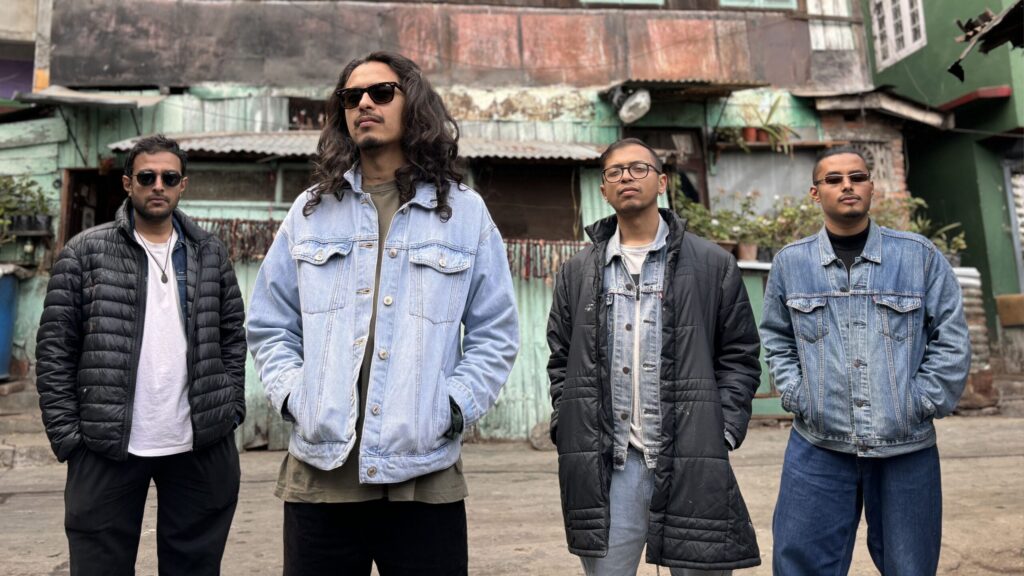
From Himalayan foothills to underground venues across India, Gauley Bhai creates music that feels both intimate and dynamic. Singing entirely in Nepali while blending rock, folk memories, blues and contemporary influences, the band tells stories about migration, identity, belonging and everyday life in the mountains they call home. In this conversation with Durum Records, vocalist and songwriter Veecheet Dhakal reflects on the origins of the band, the politics of representation, the emotional power of roots music and how Gauley Bhai turned friendship and late-night jam sessions into one of the most compelling contemporary voices emerging from the region today.
⸻
Introduction
How did Gauley Bhai start?
The band is called Gauley Bhai, pronounced “Gaon-le Bhai”, meaning “brothers from back home”. We’re a five-member collective, only four of us are on stage, but our sound engineer is just as much part of the band as the rest of us. We all sing and those group vocals really shape our sound. We’re based in Bangalore and we sing in Nepali, my mother tongue, but we’re not all Nepali speaking people in the band. We reflect India’s diversity: members come from Kalimpong in the northeast, Kerala in the south, and Bangalore itself, each bringing their own linguistic and cultural background. The band started very organically, we were just friends jamming together. Finding spaces to make noise in Indian cities is difficult, but our drummer had a place where we could play all night. Slowly, friends encouraged us to take the music outside that room, and at some point it simply became our lives.
How would you describe your music to people who have never heard it before?
That’s always the hardest question. Over time, we’ve settled on calling it Nepali folk rock. Not because we literally play folk music, but because the music carries a certain geography. People hear the songs and immediately associate them with hills, mountains, landscapes, movement. At the same time, we’re heavily influenced by contemporary music: rock, blues, hip-hop, R&B. Rock gives us freedom, it allows different influences to coexist while still carrying this powerful collective energy.
Your songs carry very rich stories. What are they about?
For me, songwriting became a way to respond to how our region is represented. I come from Kalimpong, close to the Himalayas. The way our communities are often portrayed is very simplified, exoticised even. There’s this image of Nepali-speaking communities as a “brave martial race” connected to the Gorkha army. But we are farming communities: people connected to land, music, celebration, grief, and everyday life. I wanted to tell stories that felt more honest and human. A lot of our songs explore identity, memory and place, shaped by the region’s long history of migration and political struggle.
Our first album, Joro (“fever”), explored many of these themes. One song, Nepali Ko Rela, was written during a political movement in our region and reflects both collective struggle and personal emptiness. After Joro came out in 2019, the pandemic completely changed the way we approached storytelling.Our newest album, Sunbari (‘a field of gold’), became a slower and more intimate record built from fragmented everyday stories rather than one clear narrative. Inspired by the Gandharva storytelling tradition, it focuses on ordinary lives, quiet struggles and changing landscapes, small human stories that together reflect larger social changes.
Our newest album, Sunbari (‘a field of gold’), became a slower and more intimate record built from fragmented everyday stories rather than one clear narrative. Inspired by the Gandharva storytelling tradition, it focuses on ordinary lives, quiet struggles and changing landscapes, small human stories that together reflect larger social changes.
⸻
Roots
How do your Nepali roots influence the music?
Quite deeply, though not always in obvious ways. The band’s sound comes from four musicians in dialogue with each other, all bringing different backgrounds and influences. But singing in Nepali naturally shapes the music, because the language itself carries its own rhythm, phrasing and musicality. The influence also comes from the folk songs and storytelling traditions we grew up with in the Himalayas. At the same time, the music is shaped by shared emotions and experiences that go beyond one culture. Even band members who aren’t Nepali connect to those stories and feelings in their own way.
Do you use traditional instruments in your music?
Actually, no. And that’s a very conscious choice. We don’t directly use traditional folk instruments because for us those traditions carry very deep histories and contexts. Folk music in India is connected to caste, labour, migration and social structures. I don’t think you can simply take those sounds out of their context and use them freely, because then it risks becoming cultural extraction. So instead of directly using traditional forms, we work with what I’d call “the memory of tradition.” For example, I play violin, but I’m deeply inspired by the sound of the sarangi. That influence enters the music more emotionally rather than literally. We translate those feelings into contemporary instruments and modern arrangements.
What does the word “fusion” mean to you?
Honestly, in India the word “fusion” carries a lot of baggage. Traditionally, fusion here refers to musicians combining classical Indian music with jazz structures or technical improvisation. What we do feels different from that. We’re not playing classical forms or trying to merge two forms of music together, we’re simply making contemporary songs that carry a certain geographical and emotional aesthetic. We’re influenced by folk music, but we’re equally influenced by blues, hip-hop, rock, and contemporary music from around the world. I think what influences us more is the idea of ‘roots music‘: music that carries a strong sense of place and history, even when it evolves into something modern.
Live
What do you want people to feel during your live performances?
I think we’d be happy if people leave feeling something personal inside themselves. Even if they don’t understand the lyrics, we hope the music allows them to connect emotionally: to let go, to dance, to reflect, to find their own meaning inside the songs. Sometimes people come up to us after a show and say, ‘I didn’t understand a single word you were singing, but I still felt something very deeply.’ That means everything to us.
Is there a performance you’ll never forget?
Probably our very first performance in Bangalore, before we were really a band. Something clicked during that set, it suddenly felt like more than just a project. After that show, we decided to take it seriously and to become a band. Another one was at a small film festival in Kerala. The audience was completely different from what we’re used to, mostly children and families quietly sitting on plastic chairs. It made the performance very intimate. We were able to share the stories behind the songs and suddenly the distance disappeared completely. That performance taught us how deeply people can connect across geography and language.
⸻
Inspires
What’s next for Gauley Bhai?
We recently released our second album, Sunbari, and now we’re developing new live versions of those songs. We also opened a new studio space in Bangalore. It’s become a collaborative environment where musicians, filmmakers and other artists can work together. At the same time, we’re already writing new music and experimenting with collaborations, especially with traditional folk singers from different regions of India. The next phase is really about continuing to create in this shared space.