
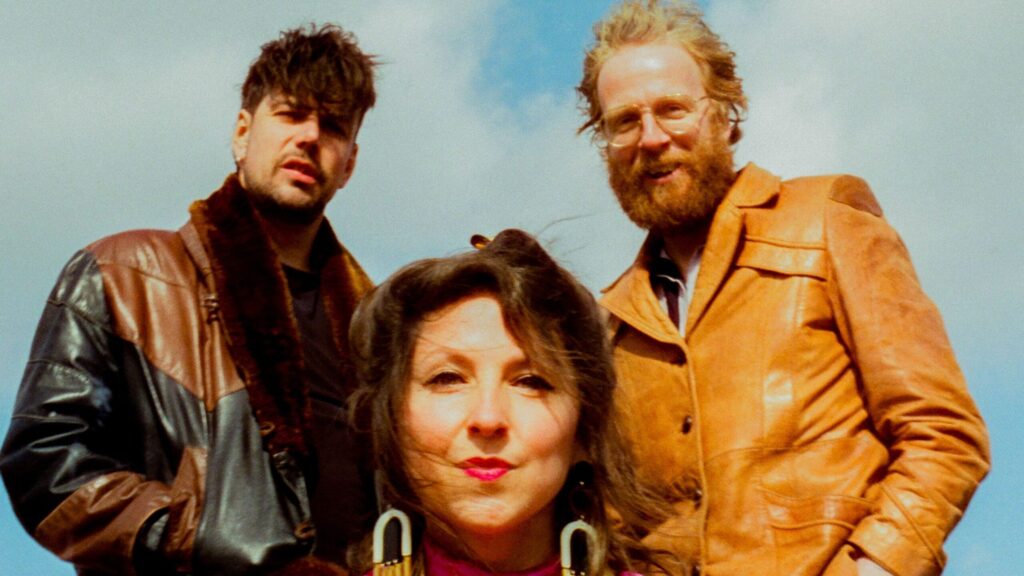
The Dutch trio blends psychedelic cumbia, vintage funk and blues into instrumental pieces that feel less like traditional songs and more like scenes from an unwritten film. Endless desert roads, faded motels and distant horizons appear through shimmering guitars and hypnotic grooves, inviting listeners to travel somewhere beyond everyday life. For bassist and songwriter Judith, that sense of escape lies at the heart of everything the band creates. Inspired by growing up in Florida, a lifelong fascination with vintage music from around the world and a constant longing for places just out of reach, Chica Chica turns nostalgia into something tangible. Their music doesn’t recreate traditions, it borrows their spirit. We sat down with Judith and Jeroen about how Chica Chica hopes to make listeners feel like they’ve travelled somewhere else.
⸻
Introduction
What does the name ‘Chica Chica’ mean to you?
It actually has a very simple origin. Chica means “girl” in Spanish, so Chica Chica is essentially “girl girl.” There isn’t a deep story behind it, I simply loved how it sounded. The rhythm of the words already felt musical, and because this started as my own project, it immediately felt like the right name. Sometimes that’s enough.
How would you describe your music to someone who’s never heard you before?
It’s like a soundtrack. That’s probably the easiest way to explain it. Whenever I write music, I immediately see images. I picture driving through endless desert roads, passing old motels, disappearing into landscapes that feel far away from everyday life. Musically there are influences from psychedelic cumbia, vintage funk, blues and Latin American rhythms, but I never think about genres while writing. I think about atmosphere. If people close their eyes and suddenly feel like they’re somewhere between Mexico, Texas and an old western film, then we’ve probably done our job.
However your music is instrumental, what stories do you want to tell?
Almost everything I write revolves around longing. Longing to be somewhere else, another country, another time, or simply being on the road. That’s really the emotional core of Chica Chica. As a child I grew up in Florida before moving back to the Netherlands, and I think part of me never completely lost that feeling of living between places. I love colours, different climates and cultures, and I’m naturally drawn to music that feels like it comes from somewhere else. Even our more upbeat songs usually carry a small layer of melancholy. There’s always a sense that you’re reaching for something just out of sight, whether that’s another summer, another memory or another horizon.
⸻
Roots
Which artists have influenced your sound?
My influences have become a real mix over the years. I spent a long time listening to American music and blues, but everything changed when I discovered Peruvian cumbia. Los Mirlos were one of the first bands that completely grabbed me, and through them I found an entire world of chicha and cumbia artists. At the same time, I’m fascinated by music from the 1960s and ‘70s, regardless of where it comes from. Analog Africa has released incredible compilations from places like Benin, and there are amazing funk records from Vietnam and other parts of Asia. It’s not so much about one specific country, it’s about a certain era. So much adventurous music was made during that period, and there’s a rawness and confidence that still feels incredibly fresh today. I think everything we borrow for Chica Chica shares that same understated coolness.
Traditional instruments and vintage gear appear throughout your music. How do they fit into your sound?
Traditional instruments aren’t the starting point of our music, but they naturally become part of the process. Our producer Gino has travelled extensively and collected instruments from all over the world. More importantly, he understands the musical language behind those traditions, the rhythms, the feel and the subtle details that make them unique. In the studio he often adds percussion or instruments that gently expand the world of a song. Outside the studio we keep things much simpler because we’re only a trio, but the fascination with old sounds remains. We’re all drawn to vintage equipment. Our guitars, basses, drum kits and effects mostly come from the 1960s and ’70s because they have a warmth and character that fits the music perfectly. I’m also slightly obsessed with the guitar sounds of early Peruvian cumbia and chicha recordings. Blues history is incredibly well documented, you can find exactly which guitars and amplifiers people used, but with old South American records that information is much harder to find.
How does a new Chica Chica song come together?
Most songs still begin at home with just me (Judith), a guitar and my laptop. I’ll start by searching for old drum grooves, often taken from vintage recordings, and then build melodies on top of them. Sometimes it starts with a bass line, sometimes with a guitar riff, but at first it’s really just a rough sketch. Once there’s a basic structure, I bring it to the rest of the band. That’s when the songs really start to breathe. Jeroen adds his ideas, Luke experiments with rhythms, and together we reshape the arrangement. I usually write quite systematically, but as a band we turn those sections into something that feels much more like a story. Even after we enter the studio, the music keeps evolving. Our producer, Gino Bombrini, often contributes extra ideas or unexpected changes, and once we begin performing the songs live, they change again.
What does the word ‘fusion’ mean to you?
It’s funny because “fusion” has become such a popular word, but I don’t really identify with it. People hear it and immediately think of jazz fusion, or nowadays it’s used for almost everything, from music to food. To me, though, almost all music is fusion. Every tradition has always borrowed ideas from somewhere else. That’s simply how music evolves. The interesting part is finding the balance between respecting traditions and allowing your own influences to shape something new. If we were trying to recreate Chicago blues exactly as it sounded in the 1950s, that wouldn’t feel honest, we’re making music in the Netherlands in 2026. We’d rather let those influences meet Peruvian cumbia, vintage funk and psychedelic rock, and see where that combination naturally leads us.
Live
What do you hope people experience during a live show?
More than anything, I hope people feel like they’ve stepped into another world for an hour. That same feeling of longing that sits inside the music, I hope the audience experiences it too. Maybe it reminds them of another place, another summer or another version of themselves. For me, everything starts on stage. When the band feels completely connected, something happens that’s bigger than simply playing the songs correctly. The audience notices that immediately. I just love seeing people completely absorbed in the atmosphere, forgetting about everyday life for a while. That’s exactly why I go to concerts myself, to escape for a moment, to admire musicians who inspire me, and to leave feeling like I’ve travelled somewhere else without ever leaving the room.
What live moment stands out for you?
One that always comes back to me was a small show at Bar Lazy in Maastricht. On paper it really shouldn’t have worked. The venue was an old butcher’s shop with a low ceiling, the acoustics weren’t great, and almost everything about the setting felt far from ideal. But somehow none of that mattered. As we started playing, more and more people walked in, and you could feel the atmosphere building. By the end, the entire room was completely with us. Everyone seemed to disappear into the music together, and that’s exactly the feeling we’re always chasing. It’s a good reminder that a memorable concert isn’t necessarily about having the perfect stage or the biggest audience. Sometimes it’s simply about a room full of people sharing the same moment.
⸻
Inspires
What’s next for Chica Chica?
Right now, all our attention is on the release of our second album in September. There’s a lot happening around it: festival shows, release concerts and introducing the record to as many people as possible. After that, the goal is simple: play these songs live as much as we can. At the same time, we’re already thinking about what comes next. We’d love to start writing new material fairly quickly, and we’re exploring the idea of collaborating with a guest musician on a future EP. For us, making music is a continuous journey. As soon as one destination comes into view, we’re already wondering where the next road might lead.