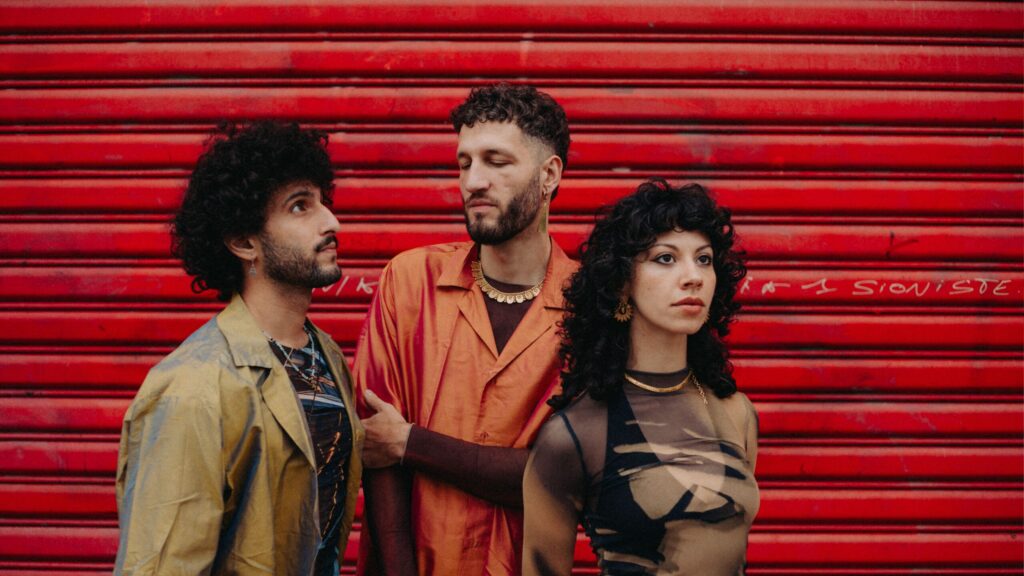
Traditional instruments, psychedelic rock, electronics and cinematic sounds collide in the music of Ko Shin Moon. The Paris-based project moves freely between musical worlds, drawing inspiration from South Asian and Middle Eastern traditions, 1970s Bollywood soundtracks, electronic music and psychedelia. For Ko Shin Moon, however, bringing these influences together is about more than simply mixing genres. Their music reflects the way sounds travel between places, are reinterpreted by different cultures and return in unexpected forms. We spoke with Ko Shin Moon about the story behind their name, learning sitar in India, the influence of film music, playing across Asia and the increasingly cinematic direction of their next album.
⸻
Introduction
Why the name Ko Shin Moon?
The name comes from an album ‘Cochin Moon’ by Haruomi Hosono, the bassist of Yellow Magic Orchestra. I discovered his music around ten or fifteen years ago, and what fascinated me was the way he combined traditional sounds with experimental music, psychedelic rock, disco and electronics. The album itself was inspired by a trip Hosono made to India. He wanted to create something like a Bollywood album, but what came out was his own interpretation of those influences. That idea became very important to us: music travels from one culture to another, gets interpreted differently and sometimes travels back again in another form, that’s called the feedback effect. That exchange is really at the core of Ko Shin Moon. We took the album title and rewrote it as our own name.
How would you describe your music to someone who has never heard it before?
There are elements of different traditional musics in what we do. Sometimes they form the basis of an entire song and sometimes they appear only as small references. Then there is psychedelic music, electronic music and a strong influence from film scores, especially Bollywood and Turkish cinema. What I love about Bollywood music is the freedom to put many different sounds into a single song. You can move from something very traditional or folk-oriented into disco, psychedelia or electronics. It creates this almost baroque patchwork of influences. That way of telling stories through sound has always been a big inspiration for us.
What are your songs about?
It really depends on the album and on the people we collaborate with. On our latest album, we wanted to become a little more intimate and use more lyrics that we had written ourselves. The songs touch on themes such as modernity, forbidden love and different aspects of sin, which became a recurring theme throughout the album. But there isn’t one story that defines Ko Shin Moon. Every song can have its own narrative, and when we collaborate with other musicians, their lyrics and perspectives become part of that as well.
⸻
Roots
How have your own roots influenced the music of Ko Shin Moon?
For me, it isn’t necessarily connected directly to nationality or language. My background is mixed, but I think my musical identity comes much more from everything I’ve listened to and explored since I was young. Everyone in the band has different roots and different musical interests, and those don’t necessarily correspond to where their families come from. Someone can have Moroccan roots, for example, but grow up listening mostly to rock and psychedelic music instead of traditional music. For me personally, my mother played a lot of traditional music at home. I heard a lot of oud, and through her I also discovered Indian music. She had a Ravi Shankar record produced by George Harrison, and I became obsessed with it. From there I started exploring all these different branches of music.
You also play several traditional instruments. Where did that interest come from?
I’ve always been interested in discovering music I didn’t know. When I was young, I moved from rap to classical music, rock and black metal. Eventually I discovered instruments such as the oud and sitar and became fascinated by traditional music from different parts of the world. I started listening to the Ocora collection from Radio France, which contains field recordings from all over the world. It felt like an infinite source of music. Eventually I went to India to study Indian music while also studying ethnomusicology at university. I played sitar for about four years. When I returned from India, I became interested in electronic music almost out of necessity: I had no one to play with and wanted something to accompany the sitar, so I started programming beats on a computer myself. In that sense, I came to electronic music through traditional music rather than the other way around. These days I mainly play saz and oud. At home I play a lot of oud because it allows me to explore maqam and music from the Arab and Turkish worlds. On stage, I mainly play saz.
You bring together sounds from many different places. What does ‘fusion’ mean to you?
That’s actually difficult to define. There have been so many terms over the years: world music, fusion, outernational, global sound, global beats. People keep questioning which words we should use. For me, fusion doesn’t necessarily mean bringing together two cultures. It can simply mean combining different musical languages. You could mix black metal guitar with blues, country or rap and that would also be fusion. It is about taking the techniques, knowledge and repertoire you have developed within your own musical world and combining them with someone else’s expertise or musical language. In that sense, almost any music can become fusion.
Do you see Ko Shin Moon as building bridges between cultures?
I don’t really think about it consciously. It happens naturally because these are the things I’m interested in and because I’ve immersed myself in different cultures and backgrounds throughout my life. I’m from Paris, which is an extremely multicultural city. My friends come from different countries, speak different languages and have very different backgrounds. So I don’t necessarily see myself as someone who is building a bridge. Maybe I’m simply already standing somewhere on that bridge, like many other people are.
⸻
Live
What do you want people to experience when they see Ko Shin Moon live?
Our music is mainly instrumental, with only a few vocal parts. I like that because it gives people the freedom to create their own story while listening. I don’t necessarily want people to focus entirely on the musicians standing on stage. I want them to focus on the music and on what it creates within themselves. They can build their own world around it, through the sound, through dancing or through whatever they imagine while listening. That’s the kind of experience we’re aiming for.
Is there a live moment you’ll remember for the rest of your life?
There have been many. We’ve been lucky enough to play in some very interesting places and countries. Last year, for example, we played at the DMZ Festival in Korea, which was a very special experience. We’ve also played in India and Indonesia, and what fascinates me is seeing how audiences in different places interpret the same music differently. In Indonesia, I remember people singing things over our instrumental music. In Korea, people formed a circle and started having a kind of dance battle. I love moments like that. People take the music and make something of their own with it. They interpret it however they want, and that’s exactly what I find interesting.
⸻
Inspires
What’s next for Ko Shin Moon?
First we’ll finish the current tour, with shows running until around October. After that, the goal is to focus on recording a new album. We already have songs, but we need time — and funding — to record everything properly.The music is still connected to the direction we’ve followed since the beginning, combining traditional elements with different contemporary styles, but I think this record will be more disco-oriented. I’ve always wanted to make our own kind of Bollywood-inspired album, with that richness and cinematic feeling. I’d love to work with more instrumentalists this time — brass, strings and other musicians — to make the music feel even more cinematographic. Whether we can realise all of that will also depend on the resources we have, but that’s the direction we’re aiming for.